
A Salute to Football’s Most Valuable Man as His Sun Sets at White Hart Lane
Tottenham is a club in crisis. They crashed out of the FA Cup with a loss to fourth-tier Rochester. They lost – or submitted – to Bayern, 7-2 at home. They followed that with a 3-0 drubbing at the hands of… Bright & Hove Albion.
Bookmakers swarm. Whispers of Jose Mourinho rise like creeping smoke in a building already on fire, with those inside blissfully unaware. Or maybe they are, now, after Watford, away at BHA, and Newcastle, to say nothing of what seems inevitable in the forthcoming trip to Anfield. The prospect of offering odds on Pochettino’s replacement would’ve seemed silly just months ago. If this is the beginning of the end, or more truthfully the middle of the beginning of the end, it is time to recognize just how valuable Pochettino has been to the club.
It’s important to understand the condition the club found itself in when it hired the man. The season before, between the twin failures of the Andre Villas-Boas and Tim Sherwood eras, the club had finished sixth. A fifth place finish preceded it. In 2012-2013, Tottenham took arguably one of the greatest individual seasons in Premier League history and rode it to 72 points and 5th place. Upon Bale’s departure that summer, the club found itself with €91 million lining its pockets. It spent it on Roberto Soldado, Vlad Chiriches, Nacer Chadli, Erik Lamela, Paulinho, Etienne Capoue, and a Danish attacking midfielder.
Tottenham was, and is, in the midst of an ambitious project. Oft-maligned, described by Sir Alex Ferguson as “more painful than my hip replacement,” Daniel Levy is the subject of frequent, acidic vitriol from the club’s fans. Some of this is explainable. Levy has a well-earned reputation for being a penny pincher. If he cannot sign the player his manager wants at the right price, he’s liable to go for a cheaper alternative. His strict salary structure eliminated the chances of keeping top-class players until Pochettino arrived.
On the other hand, Levy has never gotten the plaudits he deserves for turning the financial fortunes of the club around. Absent Middle Eastern oil money, Russian oil money, and Middle Eastern oil money, the club was destined to operate at a systematic disadvantage to its top-six competitors. The full extent of Levy’s endeavors to level the financial playing field deserves its own article. For now, just know Pochettino has had $34.41MM in net spending prior to last year’s Champions League run.
By another metric, he’s spent €1.41MM per point won in the Premier League.
Allow me to demonstrate that visually.
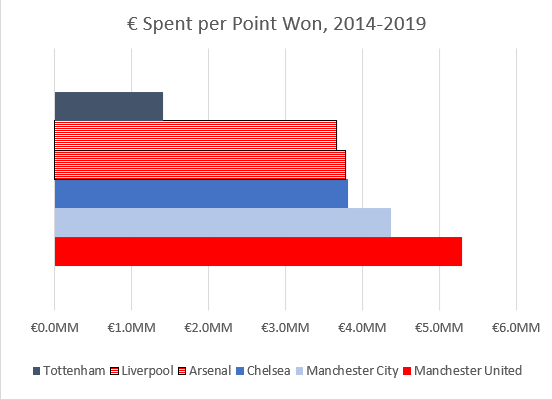
Calculated as wage bills and net transfer balance from the 2014-2015 to 2018-2019 seasons
In cultivating young talent, integrating academy products, and elevating the play of everyone who plays for him, you come to one conclusion. Since Mauricio Pochettino donned a rooster-bearing blazer, he has been the most valuable property in global football.
A perusal of the most valuable soccer players in the world feature few surprises and a lot of recognizable names. Kylian Mbappe, the heir apparent to the aught’s and 2010’s duopoly of Messi-Ronaldo debate, far and away leads with a $228 million valuation. Any self-respecting FIFA player can hear the names of the next nine emblazoned in Martin Tyler’s voice: Neymar; Salah; Kane; Hazard; This is Messi; Sterling; Griezmann; de Bruyne; Mane.
Of the top 25 players valued by transfermarkt, 21 belong to Europe’s traditional elite. Leverkusen’s Kai Havertz will be sold to one of those clubs in the next year.
And Tottenham have the other three.
The constant theme of Pochettino’s stay with Spurs (and really, his value add) is the explosive growth in valuation that his young players experience. There are several different ways to try to quantify the financial effect this has had on the club. For one, the club’s valuation has climbed from $514MM in Forbes’ estimation to $1.624 billion. Brand value has increased nearly fourfold (Statista). Harry Kane, Dele Alli, and Christian Eriksen, the three players amongst the top 25, cost the club around €17MM. They are now worth around €300MM. The first teamsheet Pochettino ever wrote, an away win at West Ham in 2014, had a collective valuation of ~€114MM.(1) The team that started 2019’s Champions League final was worth ~€615MM. Levy allowed Pochettino about €30MM, net, to spend on players in between.
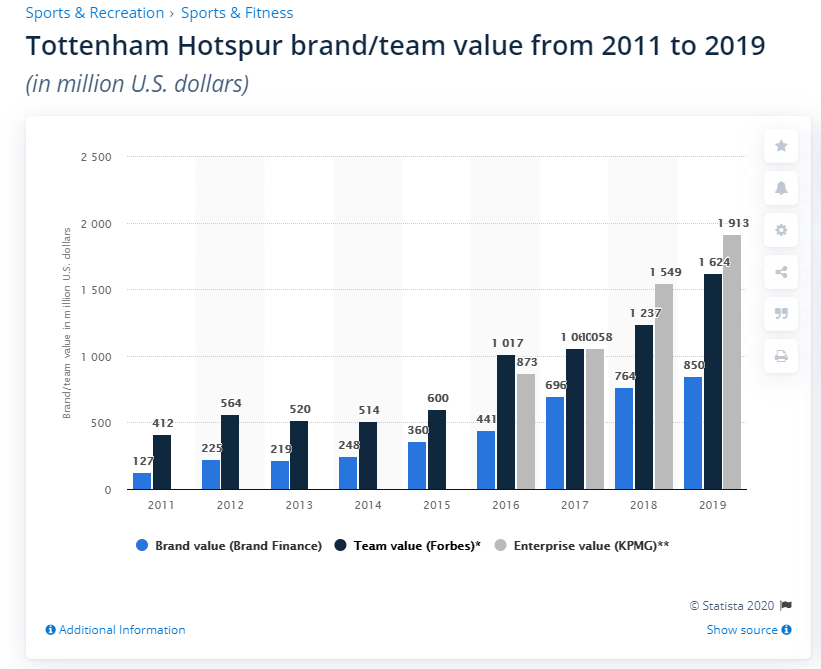
Pochettino has never had the wage bill or transfer purses of his big six rivals. Again, the development of a new training ground and stadium have played a large role – but therein lies the immense value of Pochettino. His work and results with Tottenham’s strained resources can only be described as extraordinary.
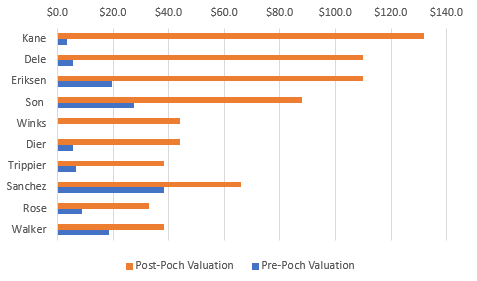
The man’s overseen a massive increase in the valuation of his squad. Not all of that figured should or can be attributed to Pochettino, of course – Kane broke out under Tim Sherwood and surely would have a top goal-scoring record no matter where he went. Alli may have made his astronomical jump at Leicester or West Ham. But when you look at the whole picture, the constant and unyielding rises in player value, it’s hard not to attribute it to the man wearing a “MP” blazer on the touchline.
All good managers increase the value of their players, of course. There’s a different challenge – and a significant amount more value – in taking Dele Alli from €5m to €99m, than a Van Dijk from €75MM to €110MM value or a Bernardo Silva from €44MM to €110MM.
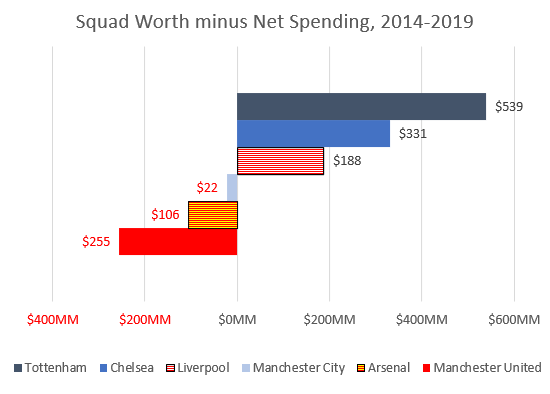
The graph above illustrates Pochettino’s gifts perfectly. Tottenham has become one of the most exciting teams in Europe in the last few years. The results alone are staggering: a Champions League final, two title runs, and consistent Champions League football. Now put that in context of the Guardiolas, Klopps, and aye, the Mourinhos of the league, and the pursestrings they get to pull on.
Stripping out the €30MM Pochettino has been able to spend, the value of his squad has increased by over half a billion dollars in five years.
Half a billion. That’s calculated net of spending.
Pochettino, barring a torrid run of results or uptick in play, looks set to leave Tottenham Way sooner rather than later. He’s frankly grown too big for the club, in much the same way Gareth Bale did, or how a group of awkward-sitting former Manchester United players insist Harry Kane is now. The common comparison is the end of Jurgen Klopp’s tenure at Borussia Dortmund. That fits. They pushed and passed higher-budgeted teams, consistently made stars of unheralded talent and dragged their team to the Champions League final.
Pochettino is its best coach in Tottenham’s Premier League history. It is not even remotely close. On the back of his work, the club moves into the future on secure financial backing. That’s more valuable than any trophy. It can be the genesis for silverware in the future.
Lionel Messi has a buyout clause of €700 million. It’s intentionally, absurdly high. And yet: Pochettino has surpassed even that figure.
The value of the club has increased by $1.11 billion over Pochettino’s reign.
Three Champions League runs, as well as a Europa League run, likely netted around €215MM. Higher finishes in the domestic table (two third places, a runners-up) brought in merit bonuses of upward of €30MM. Pochettino inherited a squad worth around $328MM. With a $34MM net spend, it is now worth just under a billion. That is a $600MM increase.
These are just some measures of the impact the Argentinean has had on Tottenham Hotspur. It does not come close to a comprehensive account of the man’s worth. But, for the last five years, Pochettino has been the most valuable property in world football. It is difficult to imagine the Special One being more special than that.
Editor’s Note: Forgive the multiple currencies used – official reports, from Transfermarkt, Statista, Deloitte, etc. are produced for different audiences.
(1)All player values courtesy of Transfermarket
 First Take Forever